
The renewables industry is constantly growing and changing, from wider adoption of electric vehicles (EVs) to complete overhauls of established energy generation networks. In 2024, renewable energy generation in the UK overtook that of fossil fuels for the first time.
Wind power is the world’s leading non-hydro renewable energy source, and here in the UK it leads by a landslide; making up a significant percentage of our entire energy ecosystem.
For decades, the UK’s offshore wind industry has relied upon the more traditional nearshore, fixed-bottom turbines. But viable nearshore sites are becoming scarcer each year, and wind farm developments are being inevitably pushed further out to sea.
We’ve already discussed the nearshore vs. deep water debate, but let’s take a look at the tech that’s emerging to specifically address deep water requirements.
The big data powering those big decisions…
NeuWave’s WAVEfinder intelligence suite provides high-resolution data analysis for offshore development and operations. Find out more.
What is floating offshore wind?
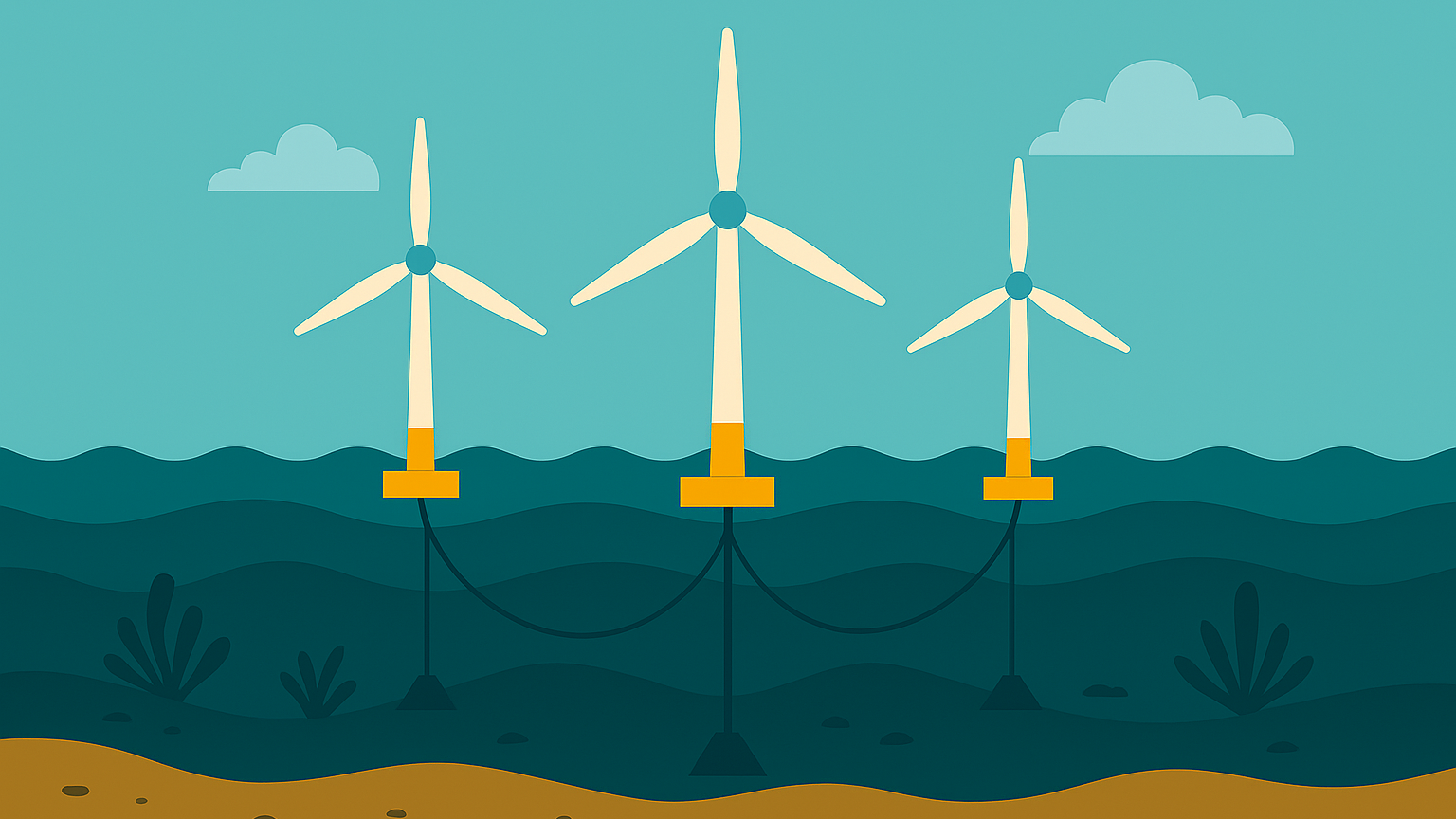
Put in the most simple terms, a floating wind turbine is an offshore wind turbine that sits on a floating platform. Like with traditional (fixed-bottom) offshore turbines, floating wind farms generate renewable energy from strong wind resources at sea.
However, floating offshore wind (FLOW) technology releases wind farms from the restrictions of shallow seabeds. Instead of relying on fixed foundations based on the sea floor, FLOW turbines instead stand on buoyant platforms that are moored via strong cables.
These structures are usually built nearer to the shore and then towed into deeper waters. Without the need for complex seabed construction, deployment is potentially faster, and causes less disruption to marine environments.
FLOW technology offers a flexible, scalable solution to the offshore wind industry that allows us to harness vast untapped energy reserves further from shore.
How do floating offshore wind turbines work?
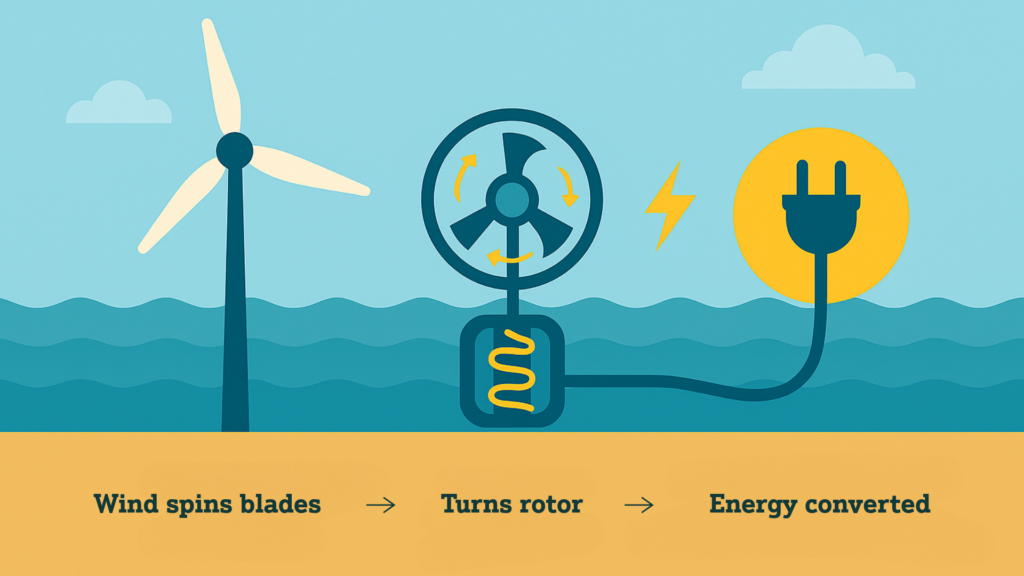
Floating offshore wind turbines generate power in much the same way as their fixed counterparts: by converting wind energy into electricity via a rotor, generator, and transformer network.
But the engineering below the surface is distinct.
The platform’s buoyancy keeps the turbine afloat, while tensioned mooring lines maintain position. These lines are anchored to the seabed using suction anchors, drag anchors, or piles, depending on site conditions (or limitations).
There are three main types of floating turbine platform:
| Type | Description |
| Spar Buoy | Long, hollow cylinder that extends downward from the turbine towerFloats vertically in deep water, weighted with a ballast to maintain stability with low centre of gravityAnchored in place with slack lines that allow it to move in the water |
| Semisubmersible Platforms | Large floating hulls that spread outwards from the turbine towerAnchored to prevent drifting |
| Tension Leg Platforms | Smaller platforms with taut lines that run straight to the sea floorRely primarily on mooring lines and anchors for stabilityLighter but more vulnerable to extreme or unexpected weather |
Dynamic cabling then connects the turbine to subsea substations, ensuring the energy can be transmitted back to shore safely. This infrastructure needs to be robust and flexible, withstanding pretty intense weather conditions while adapting to ever-changing wave motion and weather conditions.
What are the positives and negatives of floating offshore wind farms?
Floating turbines are more viable in deep waters as they’re not dependent on fixed foundations that need to reach the sea floor. Around 80% of global offshore wind resource potential is in deeper water and more remote locations. Floating offshore wind farms make this potential energy more accessible.
Each floating platform can support a wind turbine producing up to 10 megawatts of power. This is several times more than typical onshore turbines. And they’re more remote than both onshore and nearshore developments, making the visual and potential shipping impact almost zero.
Fixed foundations must be built at the operations site, and this requires extended clear weather windows. Floating turbines, on the other hand, are towed and moored into place. This can be quicker than on-site installation, but comes with its own potential downsides (not least often requiring bigger service vessels to get the job done).
There are of course a number of limitations to the deployment of floating offshore wind, especially whilst the technology and supply chain remain in their infancy. While there are obvious advantages, floating offshore wind is still an evolving industry.
We’re big proponents of floating offshore wind here at NeuWave. But it’s not all smooth sailing just yet.
Servicing assets that are further out to sea will always fundamentally require longer journeys, and more complicated logistics. Longer cables, longer supply chains, longer lines of communication, longer weather windows.
New technology also means new design principles: the trick is to design an appropriate platform setup for site-specific conditions. Foundation type and materials depend on wind speeds, wave heights, tidal flow, and weather trends. It’s a delicate decision, with the long-term survival of the wind farm at stake.
How many floating offshore wind farms are there in the UK?
The first generation offshore wind farms sprang up through the 1990s. Floating offshore wind (FLOW) is a comparatively newer development, and the very first turbines actually adapted technology from the onshore wind industry.
The world’s first floating offshore wind farm was Hywind Scotland, commissioned in 2017. Since then, there have been fewer than 10 full floating offshore wind farms built globally – with three of these being in Europe.
In the UK, floating offshore wind is at the heart of the government’s net-zero mission. Many viable shallow, nearshore sites are now used up; and this is pushing the UK’s offshore wind industry further out to sea. Since 2016 the industry has invested over £50bn in new UK offshore wind projects.
The Crown Estate recently awarded new lease contracts for FLOW projects in the Celtic sea. Once completed, these projects will make the country a world-leader in floating offshore wind farm development.
Why does the UK need floating offshore wind?
Floating offshore wind has awesome potential – it’s versatile and opens up access to essential deeper water zones where winds are stronger and more consistent. After three decades of fixed foundation turbines, it’s estimated that in the next decade, around 20% of new offshore wind could be floating.
But for floating offshore wind to truly take off, it needs to first become a more mature industry. Currently, we’re still only in its infancy and there’s a lot of big questions still to answer before floating turbines can fully replace traditional seabed-fixed wind farms.
So, what do we know for sure?
Energy prices are higher than ever, we’ve got less viable nearshore sites, and we’re experiencing more unexpected or extreme weather events than in recorded history.
Floating offshore wind farms might just hold the key to independent, secure, green energy for the UK.
Floating offshore wind has the power to transform how we approach renewable energy, unlocking deeper waters, reducing environmental impact, and ultimately putting more clean energy on the grid. Like any new burgeoning technology, it faces hurdles and we’re yet to see exactly how these will be overcome.
Let’s redefine the future of offshore wind, together…
NeuWave’s high-resolution wave data supports robust planning for offshore development; from early site assessment to O&M logistics. Get future-ready, and compliance-confident with automated reports, backed by decades of hindcast data.