
Towards the end of January this year (2026) a remote Scottish port – Stornoway, in the Outer Hebrides – received £3.5m in funding to expand upon its deep-water renewable energy facilities. Whilst this particular build-out is intended to strengthen local development, the UK is making moves to reinforce its national-level renewables supply chain and infrastructure.
Is it to be onshore or offshore wind? That’s usually the question. But in recent years the feasibility of sites that are situated even further offshore in deeper waters has caused further debate. The question becomes: is nearshore or deep water offshore wind better for the UK’s renewable energy future?
There are strengths and limitations to both approaches; especially when factoring in the realities of the UK’s geography, port capacity, technical abilities, and existing infrastructure.
So, where does the UK go from here? And which method of wind power production is the best approach?
Let’s dive in…
Build offshore projects on stronger foundations…
NeuWave’s data models deliver validated wind, wave, and current insights to support smarter site selection, robust engineering design, realistic operational forecasting, and hindcast data for test validation.
Nearshore offshore wind – the basics
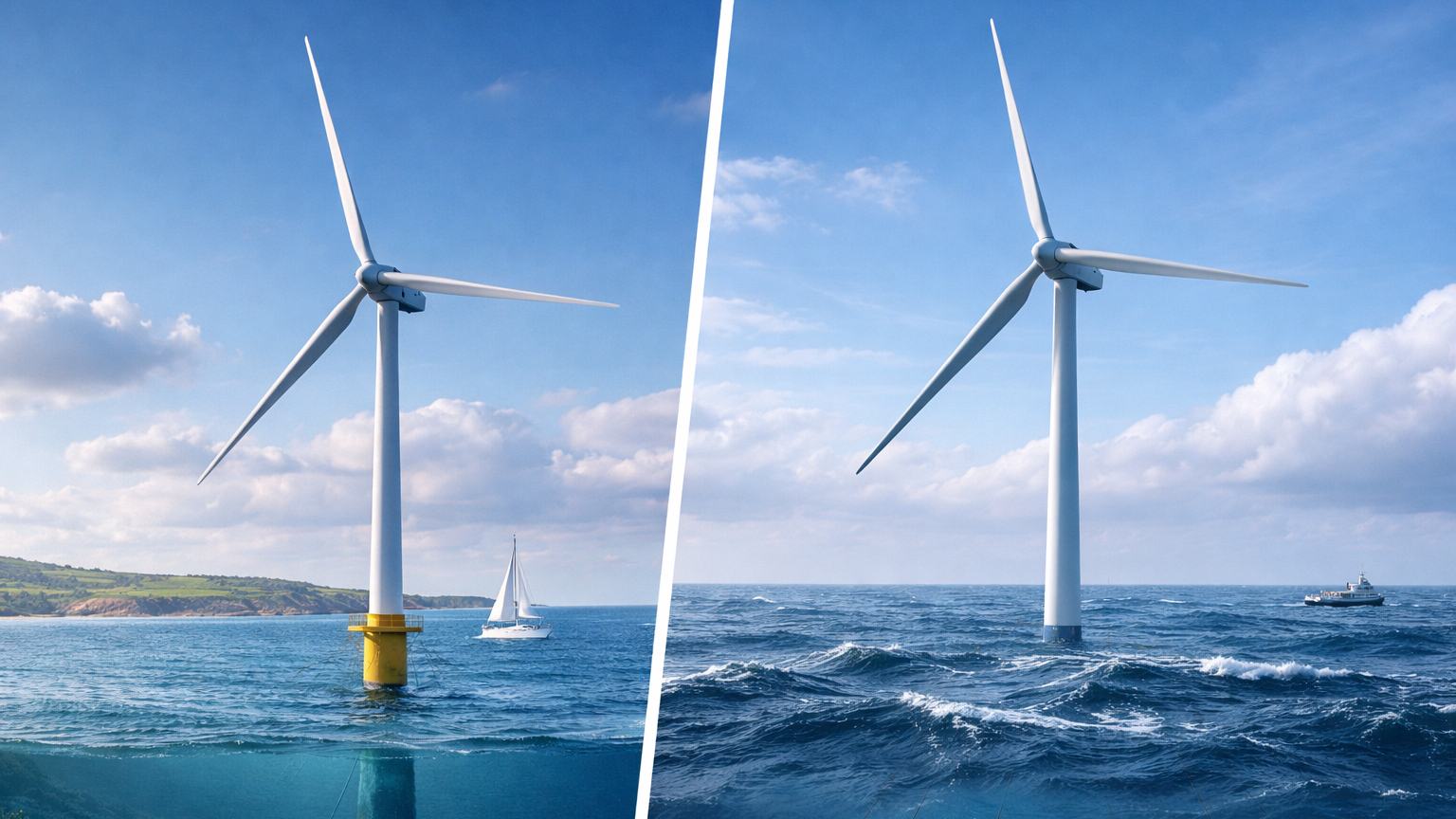
A nearshore wind farm is typically located in shallower waters (generally <50-60m), usually less than 30km from shore.
The majority of the UK’s existing and operational offshore wind capacity is categorised as nearshore. Most of these wind farms feature fixed-bottom turbines, and are supported by mature international supply chains that have been developed over decades. There are some strong reasons for this, it hasn’t happened by chance.
Nearshore offshore wind can be tricky, though, as conditions closer to shore are often more volatile. A lot of the UK’s demonstrators are positioned nearshore and there is a strong argument for upgrading rather than replacing (and relocating) the country’s existing offshore wind assets.
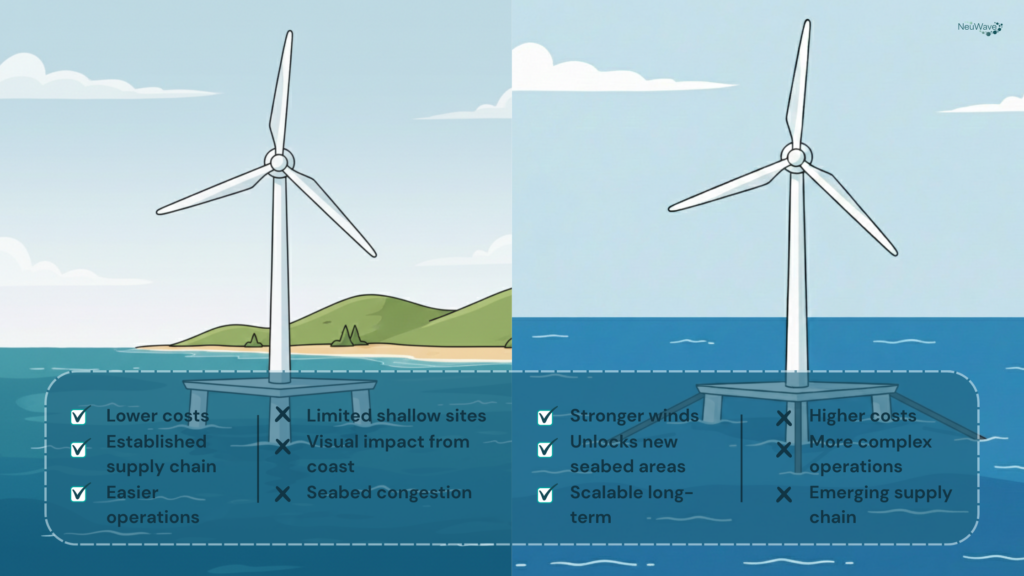
| Advantages | Limitations |
| • Easier grid connection • Better vessel access • Lower installation and O&M costs • Shorter transit times → reduced weather exposure risk | • Visual and coastal community impact • Seabed congestion (shipping lanes, cables, fisheries) • Increasing competition for shallow sites • Environmental sensitivities (MPAs, bird migration) • Conditions can change quickly |
Generally (read: if all goes to plan!) nearshore wind farm developments are more cost effective, and will be easier to access for construction, and long-term operations and maintenance. Ultimately, jobs are quicker and infrastructure cheaper if it doesn’t have to run as far, or for as long.
And honestly, we’re hesitant to list the coastal community impact as a limitation here. For the most part the public now understands the benefits of offshore renewable energy, and the NIMBYism of bygone years has lost ground to the economic and employment benefits that offshore wind development can provide to coastal communities.
More often than not, offshore wind is now framed as opportunity rather than obstruction. Regeneration funding, supply chain contracts, and skilled technical roles have shifted local narratives.
Opposition hasn’t disappeared entirely, but it’s no longer the defining constraint it once was.
Where it’s possible it’s easy to see why the UK has historically prioritised nearshore wind development. It’s faster to deliver, easier to maintain, and supported by a supply chain that has already absorbed a decade of lessons learned. In pure delivery terms, it’s still the backbone of UK offshore wind.
Deep water offshore wind – the basics
Of course, the depth of the sea isn’t always dictated by its distance from the shore. Deep water offshore wind farms are usually defined as those located in depths of over 60m; but they now often reach much deeper.
Because of its long-standing history and the natural geographical reality of the UK’s small size, a large portion of the suitable shallow seabed is already leased. And it’s pushing offshore wind developments into deeper, more hostile sites.
In the face of difficulties and costs, most of the UK’s largest offshore wind farms are those which are in deeper waters, and situated further from the shorelines.
It’s estimated that the ocean space beyond the reach of conventional offshore turbines makes up 80% of the world’s maritime waters. Additionally, the strongest wind resources are those further out to sea.
| Advantages | Limitations |
| • Stronger wind resources • Unlocks vast seabed areas • Scalable turbine and farm sizes • Port and fabrication opportunity | • Higher capital expenditure • Higher financing risk perception • Complex structural dynamics • Challenging installation and O&M • Technology still scaling (e.g. FLOW) |
Operating in more hostile environments is expectedly more expensive, and by its nature is reliant on complex operational systems. Even at the most simple level, it takes more time to reach assets that are located further away (from the shore).
As usually happens, this push into deeper waters has spurred industry advancement. From improved turbine technology, to smarter port and infrastructure development, better installation methods, and government-level support in the future of offshore wind.
Beyond a certain depth fixed-bottom turbines become a hindrance rather than a strength, and the UK has started exploring the possibilities that may be unlocked by floating offshore wind. This isn’t just theory either, with significant capacity being awarded to FLOW developments in the most recent Crown Estate allocations.
Moving deeper unlocks scale and resource, but it raises complexity in equal measure.
Deep water is more tricky because of the cost of taking the turbines out in the first place; and since trips to site can take longer than the average office working day, vessels and personnel need to be re-fuelled whilst at sea. When things get delayed, this gets difficult and costs ramp up quickly.
Comparing nearshore vs deep water offshore wind
A. Energy yield potential
Deep water sites generally experience higher average wind speeds as they tend to be further from shore.
Higher wind speeds generally does = higher potential capacity.
However, it also means greater structural loads, increasing wear and tear and maintenance requirements. In short, there’s a balance to be struck with technical feasibility, as well as site accessibility and operational reality (how hostile the site has the potential to be).
B. Capital expenditure
Nearshore, fixed-bottom offshore wind farms often come with lower construction and installation costs; and are backed by an established national and international supply chain. Deep water offshore wind, on the other hand, can be more expensive to install and maintain. Though the capacity output benefits may outweigh these costs.
C. Operational risk
Operations and maintenance costs make up most of the expenses for offshore wind projects.
Nearshore assets take up shorter vessel transit times and weather access windows, making these easier to plan for – and respond to potential emergency requirements. Deep water projects face higher wave heights and potentially more volatile sea states, enhancing the complexity of maintenance logistics.
D. Environmental and planning
Whereas they may be easier to access, nearshore sites are getting harder to secure around the UK’s coastlines.
Deep water offshore wind developments face potentially fewer direct coastal objections, making it easier to get them off the ground and running. They also offer reduced visual intrusion, and are less likely to block essential shipping or fishery routes.
However, deep water wind farms often must contend with complex and/or protected marine ecosystem interactions. Bird and marine mammal movements, as well as fish feeding, breeding, or migration patterns, must all be carefully weighed against site planning.
It’s not that this isn’t an issue for nearshore wind projects. But this is further complicated by remote site positioning, which often comes with less understanding of local natural ecosystems.
The UK’s current offshore wind ecosystem
Most of the existing offshore wind projects in the UK are fixed-bottom, and located relatively nearshore. These include some of the largest offshore wind farms in the world.
As it currently stands, the UK is a global leader in offshore wind capacity and generation. According to the Crown Estate’s own offshore wind map, there was over 52 TWh generated by offshore wind in the past 12 months – or around 16 GW generated in 2025.
That’s not bad going, and despite some slower years we’re not far off the 2030 targets. Some particularly exciting developments, including expanded floating offshore wind (FLOW) projects, were given the green light in the most recent allocation rounds.
The UK’s offshore wind success has been built on a combination of favourable seabed conditions, strong wind resources, stable policy mechanisms (for the most part), and a mature developer and supply chain ecosystem. Projects in the North Sea and Irish Sea have also benefitted from relatively shallow waters, and proximity to established ports and grid connection.
There’s been a rapid expansion in UK offshore wind, and the 50 GW by 2030 target means that the obvious sites are now mostly spoken for. Leasing rounds are expanding further offshore, and deeper waters are moving from experimental to strategic.
Basically, the UK’s offshore wind capacity is moving into deeper waters.
What is the best type of offshore wind for the UK?
If this were purely a cost conversation, of course, nearshore would win. Fixed-bottom wind farms in shallow, accessible waters will always be cheaper to install and easier to maintain than those in deeper waters.
But shallow sites aren’t infinite; and the UK’s energy demands are constantly rising. With seabed availability tightening and turbines getting bigger, environmental scrutiny is also intensifying. And at the end of the day, the windiest resources sit further offshore. Unlocking deep water sites means unlocking long-term scalability for UK offshore wind.
That doesn’t immediately make deep water wind farms or floating offshore wind the default, however. These developments are still more expensive to maintain, and they’re harder to get online in the first place. Not least, the transition will require extensive (and expensive) port and grid upgrades.
Investment and financing structures are also still adapting to the unique challenges posed by deep water conditions. And it can make proving claims and setting premiums more difficult in offshore asset insurance.
It’s pretty clear that nearshore projects will continue to dominate in the near term. So, which is best?
- Nearshore builds the base
- Deep water expand the frontier
Ideally, the UK can handle both.
Data systems for offshore wind farm development
Offshore wind development is, at its core and throughout every lifecycle stage, an environmental intelligence problem. Every offshore wind project – whether in shallow or deep waters – is governed by immovable environmental pressures and conditions.
How does NeuWave clear the fog? Environmental uncertainty easily becomes financial exposure for offshore wind developments.
At nearshore sites, complexity drives from congestion. Shipping lanes, cable corridors, protected marine habitats, other wind farms. Shallow water seabed variability can push these elements ever-closer and nearshore offshore project management requires high-resolution metocean and geospatial data to avoid costly mistakes.
Deep water offshore wind is defined by wave climate and accessibility. Significant wave height, peak period, daily or long-term conditions, and extreme storm events directly influence floating platform stability, mooring fatigue, installation windows, and long-term O&M access.
High-resolution, site-specific wave modelling underpins structural design assumptions and lifetime risk forecasting.
In the coming decades, the UK doesn’t necessarily need to choose between shallow and deep offshore wind generation. Nearshore offshore wind built the UK’s leadership position, and it’ll be a while before many of the existing projects go offline. Deep water offshore wind will likely define the next chapter of the UK’s renewables journey.
Across every depth and distance, one constant remains: projects succeed when environmental risk is properly understood, modelled, and managed from day one.
Deeper waters demand deeper data…
NeuWave’s high-resolution metocean and environmental intelligence solutions support offshore operations and wind developments. From early site screening and installation planning, to lifetime structural risk analysis.