Conducting operations and construction in volatile offshore environments requires more than ambition and funding; it demands the blending of intelligent tools and accurate, high-resolution data. Global energy demand keeps growing, and the UK’s energy transition hinges on offshore wind. But poor data, coarse models, and unpredictable sea states are slowing progress.
So how can smarter Environmental Intelligence tools help developers close the gap between ambition and delivery?
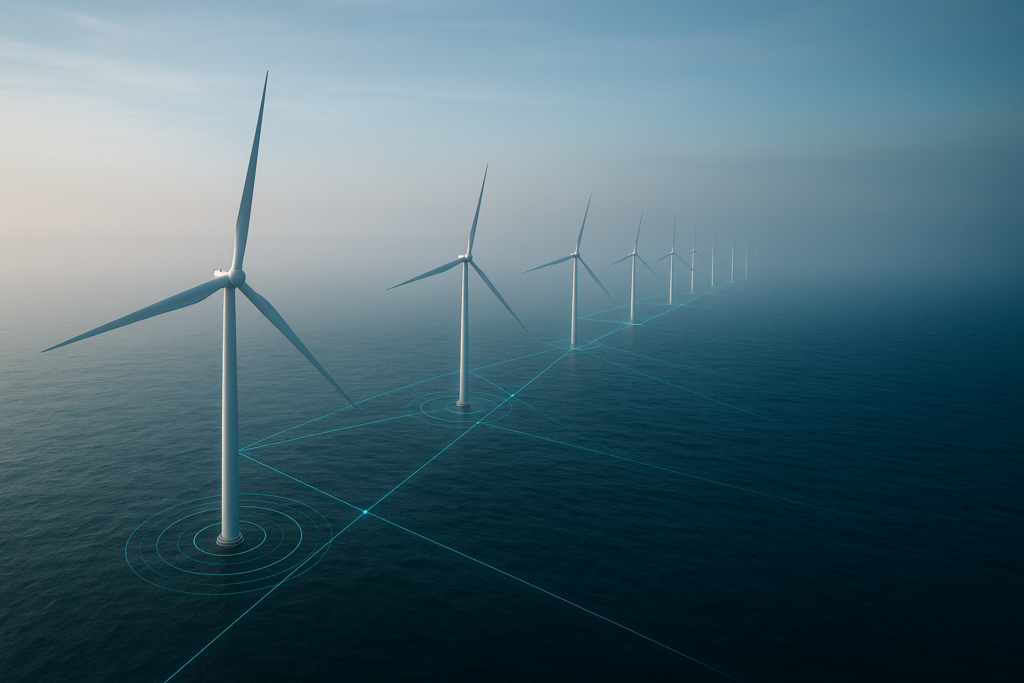
Why smarter seas are essential for a net-zero future
To have any chance at achieving net-zero goals the UK needs to successfully utilise renewable wind and wave power sources. For a group of small islands in the colder northern hemisphere, offshore renewables will form the backbone of our energy revolution.
Despite promising projections, though, the offshore wind sector faces delays, cost overruns, and consistent inefficiencies that are rooted in one critical gap: environmental uncertainty. It’s worth billions, and yet the industry (even in 2025) still relies heavily on vague trends and outdated modelling.
It’s only with smarter tools processing higher-resolution data that developers are able to get future-ready insights about the real conditions of their site. For offshore wind to truly deliver on its net-zero promise, it needs to utilise real environmental insight.
What is Environmental Intelligence?
Environmental Intelligence (EI) refers to the integration of environmental data with advanced modelling tools (including AI) to support better decision-making in complex natural systems. In offshore renewables, that means understanding the sea in real-time and across decades. Hindcast wave conditions, live forecasts, and predictive insights that help effective planning and operations.
Critically, EI isn’t just about having data; it’s about making that data usable. Environmental models only become useful when paired with accessible interfaces – ones that help planners see when it’s safe to launch a crew vessel, or when a turbine foundation might be at risk from seasonal changes in wave height.
At its best, EI reduces reliance on generalised assumptions and replaces them with site-specific clarity. In a sector where every delay can cost in the millions, and every access window matters, that clarity becomes a serious competitive edge.
Environmental Intelligence helps close the loop between what’s happening in the ocean; and what gets done about it on shore.
Environmental blindspots in offshore wind development
Between regulation and practical necessity, it’s not just the ocean itself that can be hostile for offshore projects; developers are operating in volatile environments of their own.
Current industry-standard tools offer reanalysis data at a resolution of 25 to 30km. That scale might be sufficient in the deep sea, but it falls apart nearshore (where most offshore wind farms are located). Developers are working with wave errors that are metres-high. In practice that translates to false weather downtimes, misjudged vessel access, inefficient navigation, and other costly miscalculations.
Using legacy assessment methods, environmental data is ultimately too coarse to account for coastal bathymetry, tidal currents, or seabed interaction. The result is delays which are costing the industry an estimated £250m per year. And as projects are forced into more complex sites the problem will only compound, year-on-year.
Poor data is also shaping infrastructure design and risk calculations. The cost of getting it wrong isn’t just financial, and it doesn’t just affect timelines. It can lead to inappropriate design, underused weather windows, and increased safety risks for construction or maintenance crews.
If offshore wind is going to scale up, it can’t continue relying on 20th-century models. It needs to see clearly, and developers need to know exactly what the ocean is doing.
The science behind smarter seas
Most offshore decisions depend on understanding what the sea is doing and what it’s likely to do next. That’s the promise of smarter seas: not just more data, but better decisions. From vessel routing and crew transfers to turbine design and subsea cable protection, the risks and opportunities in offshore renewables are shaped by ocean dynamics.
Yet many industry-standard models have over-simplified those dynamics. ERA5, widely used by offshore development teams, provides ocean data at a 25–30km resolution. It offers valuable long-term climate insights, but falls short when it comes to project-level planning – especially nearshore, where seabed shape, tidal flow, and boundary-layer effects matter most.
Modern Environmental Intelligence tooling improves on this by integrating high-resolution coastal models. These analyse conditions at a much finer scale. Inputs include detailed bathymetric surveys, localised tide and current models, and shoreline interactions such as wave refraction, shoaling, and dissipation.
This produces simulations that reflect what’s happening at the actual site, not just somewhere nearby.
AI models are now expanding this capability. CNN-LSTM architectures, for example, combine spatial and temporal learning (meaning they can identify both where and when significant environmental shifts occur). Trained on long-term datasets, these models help detect seasonal patterns, abnormal wave events, and optimal operation windows that older or simpler models often miss.
This is future-focused data precision and accessibility in the offshore renewables industry. When embedded into user-friendly platforms, this allows stakeholders to work with accurate site-level forecasts without needing a PhD in oceanography.
Net-zero depends on environmental intelligence
Offshore wind projects are are expected to hit tight national and international net-zero targets, operate reliably for 30+ years, and connect seamlessly into evolving energy systems. That requires precise, real-time environmental understanding.
This is where Environmental Intelligence becomes a real essential. From the earliest stages of site selection, EI allows planners to model seabed structure and ecological conditions. This helps developers pinpoint not only the most productive locations, but also the most buildable and low-risk ones. It narrows the uncertainty gap before any other project phase.
During construction, EI tools make the difference between guesswork and preparedness. Long-range hindcast data supports better infrastructure design, informing decisions on design and installation. With accurate wave window forecasting, developers can minimise delays and avoid unnecessary stand-down days.
The benefits don’t stop at the build, with Environmental Intelligence tools also supporting smarter environmental stewardship.
When biodiversity and migration data are layered over forecast windows, planners can reduce ecological disruption and avoid seasonal slowdowns. This leads to fewer regulatory bottlenecks and a clearer path to permitting; alongside overall better environmental outcomes, and more sustainable design choices.
Because EI generates more consistent, site-specific insights, it supports the broader development ecosystem: grid operators get steadier input forecasts; insurers gain confidence in risk models; and regulators are provided with defensible, transparent assessments.
Net-zero targets hinge not only on how much we build; but how intelligently we build it. And Environmental Intelligence provides offshore renewables the clarity and control they need to scale without compromising safety, sustainability, or reliability.
The challenges ahead – unlocking EI opportunities
Environmental Intelligence is beginning to shift how the offshore sector plans, builds, and operates. But making that shift at scale comes with its own set of obstacles.
The first is legacy thinking, with many offshore developments compromising with poor data, not solving it. Years of relying on coarse models like ERA5 have normalised (and somewhat optimised) workarounds, and changing that culture requires more than better tools. It means reframing what risk looks like, and what good decision-making is based on.
Offshore projects don’t exist in isolation, they rely on dozens of moving parts – from weather feeds, bathymetric surveys, and vessel schedules, to biodiversity constraints and regulatory limits. Right now, too many of these datasets sit in silos, formatted differently or inaccessible to the wider value chain. EI works best when it’s layered, where one data point can enhance the usefulness of another.
To move forward, the sector needs clearer standards. Shared protocols for environmental data would allow developers to benchmark site conditions, insurers to assess exposure, and regulators to streamline permitting without duplicating effort. Some of this work is underway, but without industry-wide alignment, real Environmental Intelligence tools remain patchy in their impact.
There’s also the question of adoption. Even when tools exist, they’re not always accessible, either because they’re too technical, too expensive, or too disconnected from day-to-day workflows.
The offshore industries are generally resistant to change; and for EI to stick, it needs to be intuitive, affordable, and embedded in the platforms developers already use.
As the offshore renewables industry pushes into stormier and more congested waters, clarity will be its most valuable resource. We cannot meet net-zero goals with guesswork.
The path forward demands smarter tools, finer data, and a mindset that values insight over assumption. Environmental Intelligence offers a critical foundation for safer, cleaner offshore energy delivery.
The ocean will always be unpredictable; planning doesn’t have to be…
Explore next-gen Environmental Intelligence tools that offer complete site clarity – even in salty water. Forecast smarter, plan cleaner, and build with resilience from NeuWave’s platform. Purpose-built with the future of offshore development in mind.