
Industries that operate offshore must also share the oceans with diverse, vulnerable marine wildlife.
The oceans sustain life on a global scale, yet every offshore project depends on and affects them in return. Beneath every turbine and service vessel lies a complex web of ocean life; precious ecosystems that sit at the beating heart of our planet.
Environmental intelligence tools are helping operators to navigate that complexity. By transforming environmental data into actionable project insights, EI allows for better balance between efficiency and care.
Building a future where industrial ambition can align with ecological integrity.
So, let’s explore how we can work towards keeping marine ecosystems and wildlife safe, while conducting offshore operations.
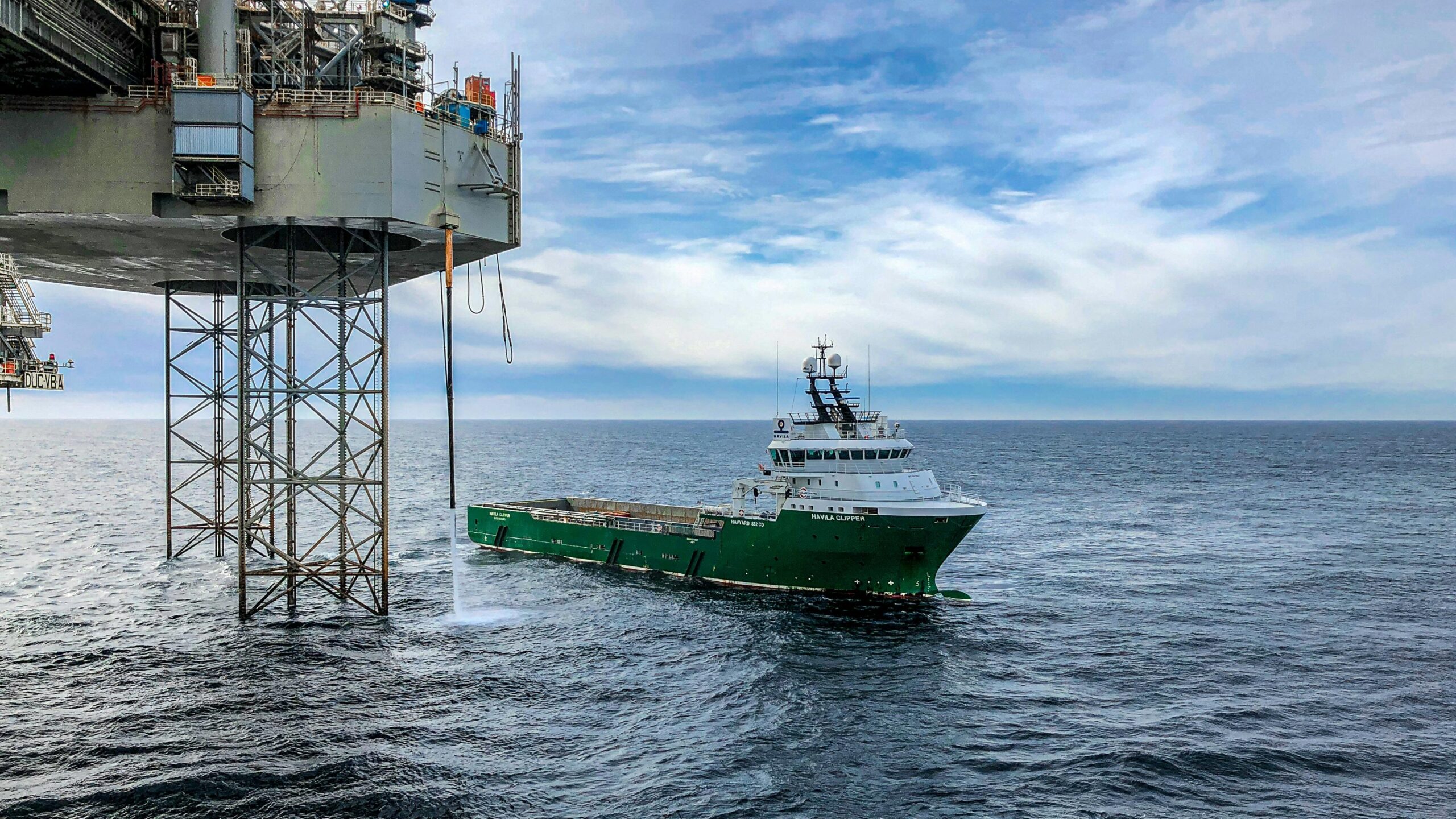
Presenting the dual challenge
To meet regulatory and project-specific pressures, offshore industries are required to constantly balance operational targets with the (often fragile) marine ecosystems that house them.
The UK has invested billions into its offshore wind capacity, making this the frontrunner of the country’s green energy transition. But operations and maintenance methods still cause considerable disruption to natural ecosystems, even as turbines rise from the waves as symbols of progress towards apparently environmentalist targets.
This is the dual challenge of offshore operations: how to meet urgent climate and energy goals, without eroding the very ecosystems that stabilise and maintain our planet. With current practices every pile driven, every cable laid, represents a trade-off between progress and preservation.
Understanding those trade-offs (and their site-specific nuances) demands reliable, high-resolution environmental data. With the right intelligence, those trade-offs don’t have to end in loss.
Careful implementation and adaptive planning can help offshore developments become part of the ocean’s recovery story; fostering new reef habitats, encouraging biodiversity, and even improving local water quality. Environmental protection will never exist in isolation from commercial pressures.
Offshore projects are complex, high-stakes ventures driven by strict timelines and cost constraints. Using environmental intelligence (EI) tools to strike a dynamic balance between operational ambition and ecological integrity.
Data-driven coexistence
All offshore industries (even the less environmentally-friendly ones) already often rely on an expanse of environmental data to inform their operations and planning practices. From avoiding installation when whales are likely to be present, to designing turbine bases optimised for unique seabed conditions, monitoring fish stocks and territories, to understanding local weather patterns.
The key is being able to translate raw observations into actionable insights and decisions that balance the so-called dual challenge. Projects need environmental intelligence that reveals the hidden thresholds of nature so that industrial operations can slip seamlessly into the ecological fabric.
At its core, EI is about quantifying tipping points and triggers.
For example:
- How large can wave heights be before scour risk to foundations becomes unacceptable?
- What tidal velocities exceed the comfort zone for benthic fauna?
- Where does a seagrass meadow begin or end, and under what sediment flux does it collapse?
By layering spatial data on project zones, engineers can schedule operations to avoid crossing critical thresholds. Achieving coexistence means internalising these ecological thresholds into every layer of design and planning.
Rather than viewing nature as a constraint to work around, the industry can begin to behave as a participant within natural marine systems. Nudging, but never pushing beyond, ecological tolerances.
When EI becomes more than reactive monitoring (when it becomes anticipatory, threshold-aware guidance) then industrial scale and ecological integrity can genuinely cohabit.
Smarter navigation for sustainable seas…
NeuWave’s environmental intelligence tools combine real-time data and predictive analytics to optimise offshore operations while protecting marine ecosystems.
Regulatory alignment
The balance between offshore development and marine protection runs deeper than ethical choice. Many states and international bodies set regulatory requirements that affect offshore operations. And regulation, like the tides, is never static.
Frameworks like UNCLOS and IMO conventions, and a growing set of regional marine spatial planning directives, are tightening expectations around how offshore industries operate in shared (and sometimes even national) waters.
Each new layer of policy pushes developers towards provable, transparent, and demonstrable environmental planning.
By collecting and interpreting real-time environmental data, EI tools can be designed to map operations directly against legal thresholds (and offer reliable evidence for trials and insurance purposes).
Ultimately, regulatory alignment is about creating a shared language between industry and environment. Instead of waiting for inspections or retrospective assessments, operators can adapt their actions live; reducing harm while maintaining project momentum.
Smart spatial planning for marine environments
By implementing smart spatial planning methods, and leveraging high-resolution EI, offshore operations can be optimised for both project efficiency and ecological protection.
Considerations differ at respective project stages. High-resolution environmental intelligence allows operators and planners to steer clear of ecologically sensitive zones, migration corridors, and vulnerable habitats.
In a recent case study off southeastern North Carolina, researchers used GIS-based environmental heat maps layered with metocean data and marine species distributions to determine subsea cable paths that avoid critical zones while minimising total impact distance.
Turbine placement and vessel routing are being similarly refined. With fine-scale environmental maps of marine mammal and bird migrations, or fishery zones, shipping corridors and vessels servicing offshore sites can be timed or channelled to minimise encounters with sensitive periods.
Smart spatial planning integrates EI’s granular data directly into design and operations.
Environmental intelligence enables sustainable offshore operations
The long-term vision is to use EI not just to power renewables, but to protect the marine environments they depend upon. And the right tools transform that from method into practice.
Across offshore industries, an ecosystem of advanced environmental intelligence is emerging – from smart sensors and digital twins, to real-time acoustic monitoring and satellite-based analytics. Each innovation brings us closer to truly intelligent operations, and systems that can anticipate and adapt to environmental needs as they arise.
When these technologies converge, they create a pathway toward coexistence. One where offshore wind farms, service vessels, and marine ecosystems operate in sync with natural forces, and are guided by the same data-driven intelligence.
As regulation tightens and expectations rise, environmental intelligence is helping offshore industries stay ahead; combining compliance, performance, and stewardship. The more we understand the ocean, the better we can protect it and still keep the lights on at home.
The tools already exist, what matters now is how we use them to create an offshore future that works with, not against, the sea.
Data that thinks like the ocean…
With NeuWave, environmental thresholds, vessel routes, and habitat zones align. Delivering intelligent navigation built for coexistence, not compromise.