Digitised systems incorporating high quality, readable data and which streamline processes provide a clear and provable value to offshore wind developments. Despite this, a vast percentage of offshore wind planning, operations, costing, and continues to depend upon slow, manual systems, and siloed data.
Here at NeuWave, we spend a lot of time innovating around and discussing the inherent value of precision wave data to offshore wind. And we’ve spent the last year proving it!
But what are some of the other ways in which the industry can digitise, and how exactly can AI help better offshore wind industry and operations?
Let’s dive in.
Precision data powering offshore performance…
From planning to operations, NeuWave’s environmental intelligence data tools provide the clarity offshore teams need to optimise weather windows, cut delays, and improve project reliability.
1. Digital platforms enabling project-wide accessibility
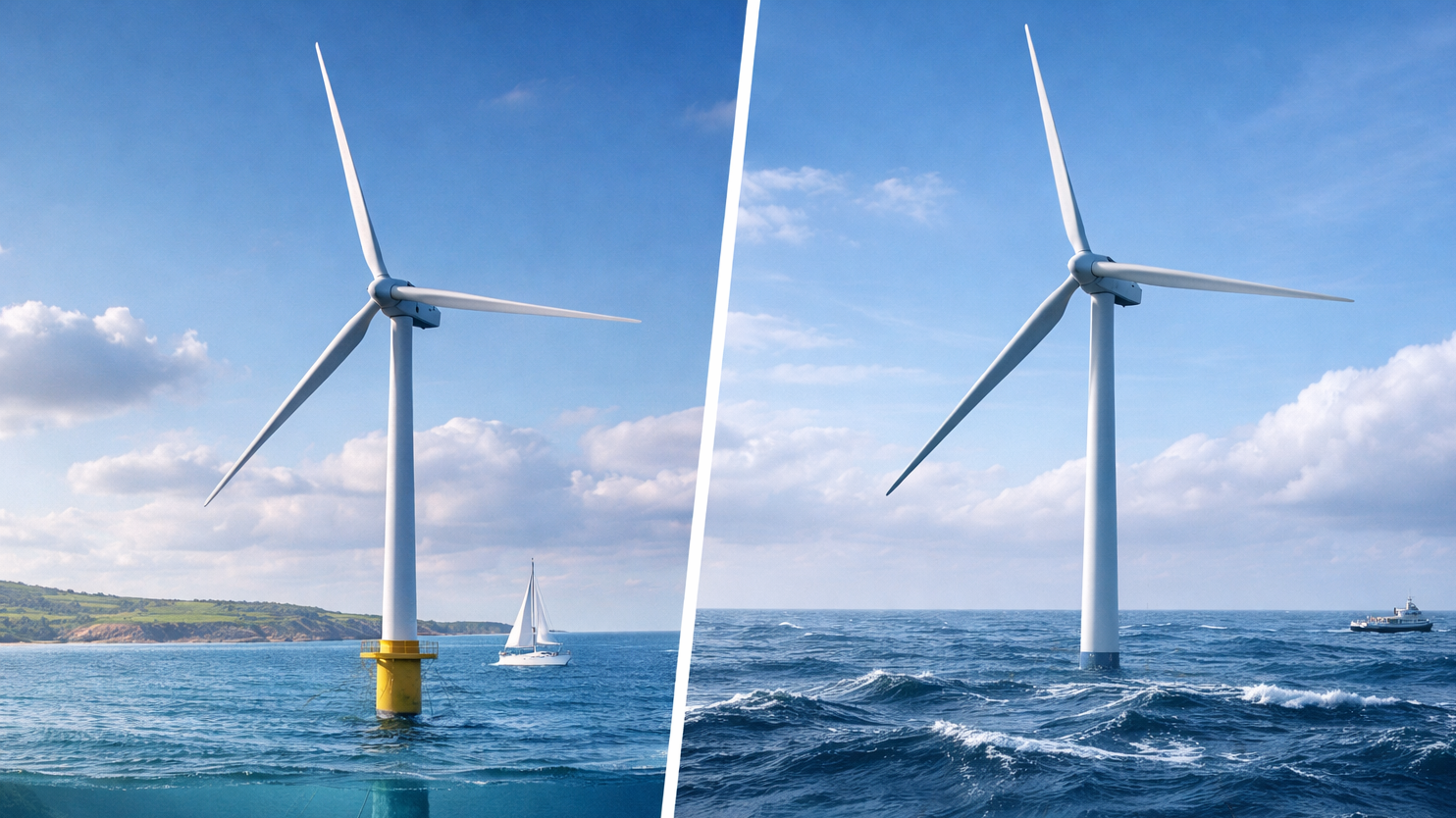
Current industry models rely on dense datasets and manual analysis, and many decisions are based on rushed attempts at understanding these impenetrable sources.
The combination of accessible (read: usable) digital technologies, and precise, quality data can be used to communicate the risks and realities of an offshore wind project to all relevant stakeholders. Whether it is an underwriter working to determine risk levels of a potential development, or a developer planning maintenance schedules for offshore wind assets; clear and readable data, which can be understood by all relevant individuals or parties, is a powerful tool.
With many development and investment contracts now lasting longer on average, this across-the-board accessibility and clarity is essential to ongoing success.
2. Automated and semi-automated vessels
When we think of automation, it’s usually in the context of manufacturing robots that complete specific tasks with pinpoint precision. Automation offshore is increasingly inevitable, and offers many of the same benefits you would expect in manufacturing: optimising costs, efficiency, and safety.
At sea, automation spans a wide spectrum – from vessels with enhanced autopilot and sensor-assisted navigation, to fully autonomous ships that are able to operate with minimal human intervention.
Semi-automated systems are already improving route planning, collision avoidance, real time conditions monitoring, and mitigating human error within offshore operations. And not all automation necessarily requires full automation; some tools will always work better with a level of human oversight or input.
Advancements in communication technologies also enable remote control and supervision, bridging the gap between shore-based operators and offshore assets. These developments support safer operations in challenging marine environments and improve uptime by enabling predictive maintenance workflows.
Fully autonomous ships are on the horizon, promising step changes in operational efficiency and cost reduction. But their integration will be gradual, and driven by regulation, technology maturity, and industry trust in AI systems.
Contributing to autonomy at sea…
We’ve been interested in ocean automation for a while here at NeuWave, and it turns out that the industry is interested in us, too! See how NeuWave data tools and research efforts are making waves in the near-future of offshore automation.
3. Digital twins and AI modelling for offshore sites
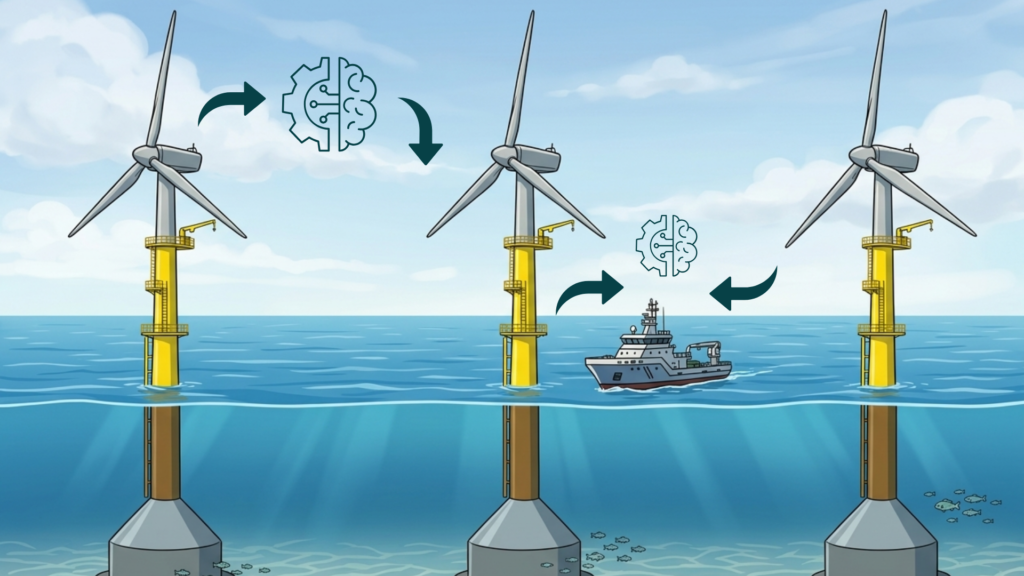
A digital twin is an exact virtual site model – including asset placement, physical forces and factors, and any other potential factors that are deemed relevant to respective developments or tasks.
By incorporating these digital mock-ups of relevant project sites into planning and operations, offshore wind developers are able to better understand local environmental conditions and weather patterns.
Digital twins also provide essential insight that guides asset design and location decisions, which impact the lifespan and productivity of entire developments.
The value doesn’t end with planning though; one of the key advantages of digital twin technology is that it provides active monitoring and predictive maintenance insights for offshore wind farms. It allows operators to continuously manage performance and detect anomalies without the need to physically access the site.
In short, it minimises weather-related downtime, offers clearer risk insights, and reduces overall maintenance costs (both day-to-day, and through preventative action).
4. Futuristic port management
Looking ahead, port management will become increasingly integrated with smart port ecosystems that leverage AI, IoT and advanced data analytics to orchestrate every aspect of operations: from berth allocation to cargo tracking and environmental compliance.
This may also include tools for workforce management, whether located on shore or aboard vessels. Personnel scheduling optimisation, safety procedures and accident mitigation, or even payroll and tax automation tools, can all provide tangible benefits to individuals and projects.
Together, these technologies lay the foundations of a more resilient, responsive management layer that boosts throughput, enhances sustainability and transforms ports into dynamic hubs for offshore project management.
5. Wind turbine design and manufacturing
Despite looking relatively simple, offshore wind turbines consist of several major and secondary components, some of which are complex, and others simply huge. They must also be able to withstand decades of exposure to waves and wind; ideally with minimal maintenance requirements.
Whichever way you look at it, they’re not necessarily easy to build.
Digital technologies such as generative and parametric design, 3D scanning, VR, AR, advanced robotics, and high resolution data analysis tools, are already being used to modernise offshore wind turbine design, manufacture and testing.
Digital tools streamline prototyping, improve testing, optimise materials and construction methodologies, reduce cost and risk, and enable real-time collaboration across teams.
6. Environmental forecasting
Obviously, we know a thing or two about environmental forecasting in offshore wind, here at NeuWave!
At its core, environmental forecasting is about turning complex, dynamic ocean and weather data into clarity – giving developers, operators, underwriters, and project planners the confidence to make smarter decisions at every stage of a project.
- Traditional models often rely on coarse, historical averages and static data, leaving gaps in accuracy that can cost time, money and safety when weather windows close unexpectedly or sea states change suddenly.
- Environmental intelligence based forecasting instead combines real-time data feeds with AI-enhanced metocean modelling to predict wind, waves, currents and other conditions with far greater precision.
This matters especially nearshore or at other complex sites, where subtle shifts in bathymetry and tidal flows can materially impact both construction and operations.
What sets this next-generation of forecasting apart is not just better numbers, but better actionability: forecasts that refresh frequently, integrate both live and historical observations, and output insights tailored to site-specific challenges. These capabilities reduce stand-down days, optimise vessel routing, and strengthen predictive maintenance planning (all while lowering risk and supporting regulatory compliance).
For offshore wind to deliver on net-zero targets and operate safely decades into the future, forecasting must be real-time, high-resolution and intelligently integrated into everyday workflows.
From autonomous vessels and smart ports to digital twins and precision forecasting, the industry is moving toward safer, more efficient, data-driven decision-making.
As projects scale in size and complexity, the winners will be those who turn environmental and operational data into clear, actionable insight and streamlined operations that are geared towards serving the future.
That’s where the real competitive edge now lies.
From ocean uncertainty into operational advantage…
NeuWave delivers high-resolution metocean data and forecasting tools uniquely tailored for each project, and designed for the offshore wind sector. Enabling safer scheduling, more accurate risk modelling, and better day-to-day operational decisions.