
Despite being one of the cleaner ways of generating energy, offshore wind (and wind farms in general) has historically commanded a divided public opinion. Everyone wants green electricity, but nobody wants turbines in their local countryside or obstructing sea-view.
This NIMBY-ism has received its own well-earned pushbacks; but the arguments against offshore wind do also run deeper, and sometimes hold a little more merit.
Concerns around the impact of offshore wind on marine wildlife and ocean ecosystems goes back decades. Ultimately, there’s no perfect way of generating energy available to us, for now at least. There’s always a compromise. But that doesn’t mean we can’t do as much environmental good as possible with the options we have.
So, aside from making operations and output more efficient, how can offshore wind farms and related infrastructure be used for even greater good? To answer this, we wanted to shed some light on contributions to environmentalism, beyond energy.
Let’s dive in!
Offshore intelligence powering the core of offshore energy…
NeuWave’s environmental intelligence tools turn complex metocean and site data into clear, actionable insight. Helping offshore projects plan safer operations, reduce risk, and better understand the environments they work within on a day-to-day basis.
Understanding the impact – offshore wind and wildlife
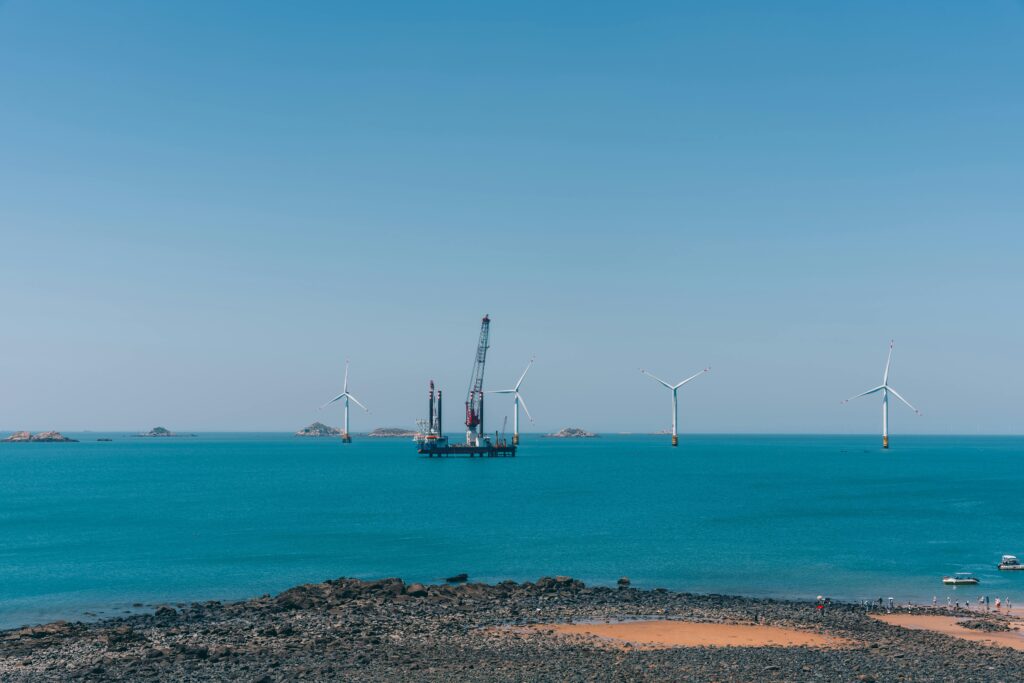
From when the first turbines were erected, advocacy groups have raised concerns about the potential impact of offshore wind for marine wildlife. In 2012, the International Energy Agency Wind Technology Collaboration Programme (WETO) initiated true international cooperation, and the industry began taking the concerns seriously.
Since then, WETO has supported international collaboration across utilities, regulation, and consumer-advocate organisations to help develop a better understanding and careful balancing of interests, when it comes to wildlife protection and essential offshore wind energy generation.
A wide variety of species are inevitably affected by offshore wind operations in the UK: from marine mammals like the harbour and grey seal, to fish species including cod, herring, and salmon (all of the latter making up human diets and having potential repercussions for fishing practices). And it goes deeper than animal impact, with seabed conditions also affected by wind farm construction and operations.
Studying ecosystems for offshore wind farms
There’s a long history of research into the effects of offshore wind farms on local marine ecosystems. And studies have been conducted from wind farm sites to help better understand these impacts.
One such recent study, which will launch in March 2026 at Neart na Gaoithe (NnG) offshore wind farm in Scotland, is the most extensive seabird monitoring project in the country.
The NnG project is intended to run for two breeding seasons, and aims to gather detailed data related to bird behaviour in relation to wind turbines. It combines Birdtrack-Radar3D monitoring (built entirely for the job) and six collision detection systems which feature several cameras and infrared illuminators on turbine towers.
This project may be the largest, but it’s certainly not the only one of its kind. Earlier studies have shown that cod, for example, are more affected by wind farm operations than construction, displaying changes to migration routes and timing. Other species are affected differently, at various stages of construction and operations.
There are, of course, still gaps in essential knowledge. But put simply, the deeper understanding enabled by research at offshore wind farms allows for optimised operations, and the ability to mitigate negative environmental impacts.
Supporting marine science through offshore infrastructure
Ultimately though, not all research conducted at wind farm sites needs to be related to wind farm effects. Offshore research is expensive and logistically complex, and often limited by weather conditions and vessel/port space availability.
Offshore wind farms offer existing sites and infrastructure that can be utilised for the study of local ecosystems. Whether it’s the re-use of vessels for monitoring, or sharing valuable environmental data, offshore wind farms can provide access to deeper environmental understanding.
By hosting scientific equipment on turbines or substations, developers can support long-term environmental monitoring at a scale that would otherwise be difficult to achieve. With permanent structures already in place, wind farms can provide platforms for environmental sensors, acoustic monitoring equipment, and oceanographic instruments.
This kind of data is invaluable not just for understanding wind farm impacts, but for broader climate and ocean health research. It also leads to innovative tools like the WhaleAlert app – used to track whales to avoid vessel collision.
In this way, offshore wind infrastructure can double as a distributed environmental observatory; contributing to global knowledge about changing marine conditions outside of the narrower impacts of offshore wind operations themselves.
Offshore wind farms as artificial marine habitats
Nature is endlessly innovative. And while offshore wind farms are built for energy production, certain species have managed to make their foundations and subsea structures into unlikely homes.
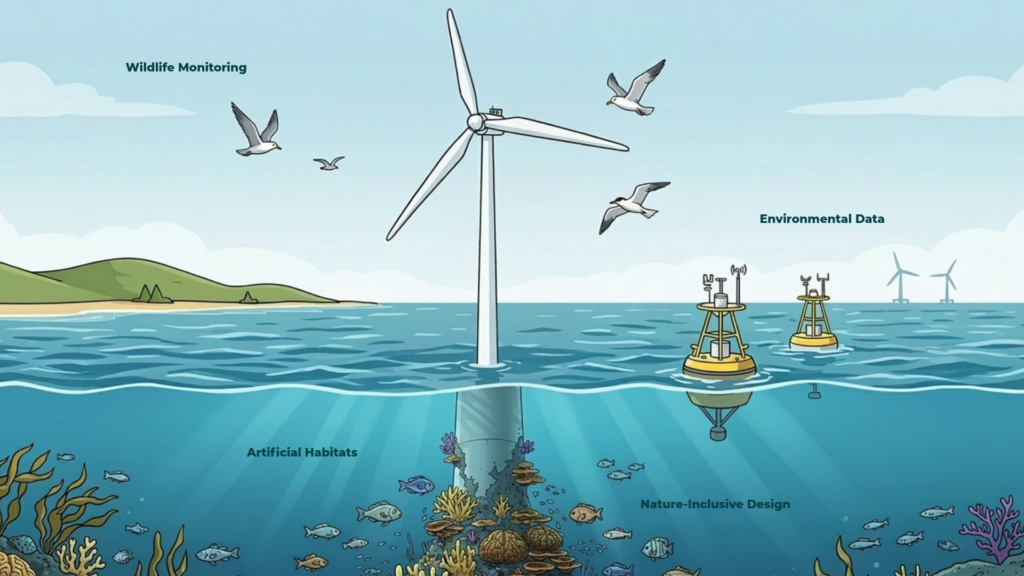
Turbine foundations, scour protection, and other subsea structures introduce hard surfaces into areas that are often dominated by soft sediments. These new surfaces are often colonised by marine life, including mussels, barnacles, coral, anemones and other invertebrates that attach to hard substrate.
Some studies have observed increases in biodiversity and biomass around turbine foundations, effectively turning parts of wind farms into de facto artificial reefs.
While this doesn’t remove wider ecosystem concerns or mean all impacts are positive, it does highlight how offshore wind infrastructure can support marine life in ways that were not originally anticipated.
Understanding these changes is essential to both manage potential risks, and to explore how future projects might be designed with ecological benefits in mind as well as impact reduction. With the right monitoring and ecological planning, offshore wind farms could be designed not just for minimising harm; but to actively support the creation of healthy new marine habitats.
Nature-inclusive design in offshore wind
As offshore wind scales up, the focus is increasingly shifting from minimising harm to designing projects that actively support marine ecosystems. Nature inclusive design (NID) embeds ecological function into core engineering choices.
At its simplest, NID means rethinking traditional components so they do more than just guard the assets.
New approaches at the Rampion Offshore Wind Farm here the UK replace conventional rock armour with eco-engineered reef cubes that both protect turbine bases and create heterogeneous habitat for fish, shellfish and other benthic species, turning structural necessities into ecological opportunities.
More systematic research backs this up. Experimental comparisons of different scour protection substrates show that surface complexity and material choice influence the diversity and functional roles of benthic organisms. In short, thoughtfully designed structures can support higher taxonomic and ecological diversity than traditional alternatives.
Beyond engineered materials, NID opens up a suite of options, all aimed at making wind farms more marine-friendly by design (rather than by accident, as mentioned earlier). It’s about being both climate-smart and nature-positive.
Mitigating the impact – environmentalism beyond energy
Offshore wind will never be impact-free. But the growing body of research and innovation around the sector shows that projects can be designed and constructed, then operated day-to-day, in ways that reduce harm while strengthening environmental understanding and resilience.
Environmentalism beyond energy means using offshore wind as a platform for wider ocean stewardship. That can include:
- Long-term wildlife monitoring that improves how we protect seabirds, marine mammals, and fish, during both construction and operations
- Sharing environmental data gathered from turbines, substations and vessels to support broader climate and ocean research
- Designing infrastructure with ecology in mind, so that features and foundations contribute to habitat complexity rather than occupy habitat space
- Timing and planning works carefully to avoid sensitive breeding, spawning, feeding, or migration periods and sites
Individually, these measures may seem small. But in culmination they represent a shift in mindset.
The move away from seeing offshore wind as a necessary environmental trade-off; to recognising it as an opportunity to better understand, protect and even enhance the marine environments it depends on.
NeuWave’s environment-first commitment
Better environmental insights are the whole reason that NeuWave exists. It’s our bread and butter (or fish and chips, I guess).
Our environmental intelligence tools empower offshore projects with better insights into real ocean conditions and operational risks. Supporting decisions that are safer for both assets and ecosystems.
We’re especially interested in collaborating with projects and researchers working to better understand marine environments. From identifying optimal monitoring windows to interpreting complex environmental data, our tools can help turn raw ocean information into practical insight.
If you’ve got a project that you think may be relevant, we’d love to hear from you!
As offshore wind expands globally, its environmental story is becoming more nuanced. Alongside renewable power, wind farms are supporting marine monitoring, habitat complexity, and ecosystem research.
This broader view of environmentalism beyond energy shows how offshore wind can move from being simply lower-carbon to being more integrated with (and informed by) the waves and winds that it operates in.
Supporting ocean science beyond offshore energy…
We partner with researchers and conservation teams to help turn ocean data into usable insight. If your work focuses on marine ecosystems or species monitoring, we’d love to discuss how NeuWave data could support your project.