
Since the results of the most recent Contracts for Difference round, it’s clear that long-term plans for offshore wind are picking up again across the UK. Offshore wind projects run for decades, and while many of the key players have been around for a while, there’s a few new pieces on the board now, too.
So let’s take a look at who actually owns and operates the UK’s offshore wind capacity, and how it works behind the scenes.
Offshore operations move with the tides…
Keep ahead of the waves with NeuWave’s deep environmental intelligence tools. Providing fast insights that can empower robust, site-specific decisions that protect assets and always meet project deadlines.
Who owns the UK’s offshore wind farms?
The offshore wind farms that power the UK are owned and operated by a wide variety of diverse actors, both UK-based and international. First then, we should take a look at who some of the key players are, and what assets they individually own and influence.
RWE Renewables
With over 20 years operating in the UK, RWE Renewables currently contributes around 4.6 GW capacity to the UK grid each year. RWE itself is a German energy company; RWE Renewables being the UK-based subsidy.
RWE Renewables own both onshore and offshore wind farms in the UK. The company’s 10 offshore wind farms are pretty spread out – based near North Wales, off of Scotland’s South West coast, with additional smaller projects running the length of England’s East coast.
Being the clear front runner in the most recent Contracts for Difference allocation round 7, RWE secured 6.9 GW additional capacity over multiple sites. These included Norfolk Vanguard East & West, Dogger Bank, and Awel y Môr (located in the Irish Sea).
SSE Renewables
Focused on delivering and developing world-class wind, solar, hydro and battery-storage assets across the UK and Ireland, SSE Renewables is the renewable-energy arm of the FTSE-100 group, SSE plc.
With a strong emphasis on community investment, nature-positive operations and a ‘just’ transition to a low-carbon world (in their own words), SSE Renewables positions itself as a leading driving force in delivering sustainable value for society and shareholders alike.
They’re another frontrunner in the UK’s offshore wind sector: SSE Renewables is currently developing the Berwick Bank projects (expanded with recent CfD), and employs over 2,000 industry professionals. The company is also active in continental Europe and Japan.
Blue Gem Wind
Owned and operated by the Simply Blue Group, a “blue economy developer”, the Blue Gem Wind partnership is a newer player on the board (established in 2020).
In the 2025 CfD round, Blue Gem was awarded over 100 MW for floating offshore wind developments in the Celtic Sea. The project, named Erebus, will be the first of its kind at this scale, anywhere in the world; and is expected to lead to the creation of over 5,000 local jobs.
Ørsted
Established over 30 years ago in Denmark, Ørsted is one of the world’s leading renewable energy providers. The company operates offshore wind across Europe, North America, and the Asia-Pacific region.
Ørsted currently own and operate 12 offshore wind farms in the UK, including the Hornsea developments. It also acquired Brookfield in 2021, a massive investor in the global energy transition with $137 billion of assets under management across over 7,000 generating facilities.
They didn’t get as much of a look-in during the most recent CfD, but remain a core player in the UK’s offshore wind makeup.
Where are the UK’s offshore wind farms located?
There are currently over 45 wind farms helping to power the UK, with 16 GW capacity and at least 10 GW more in development or planning. Of those that are already powered up, the majority of the UK’s are focused in the North Sea, Irish Sea, and around the Scottish coastlines.
These wind farms employ over 30,000 people across the UK in specialised roles, and by the end of this decade that is expected to have reached 100,000.
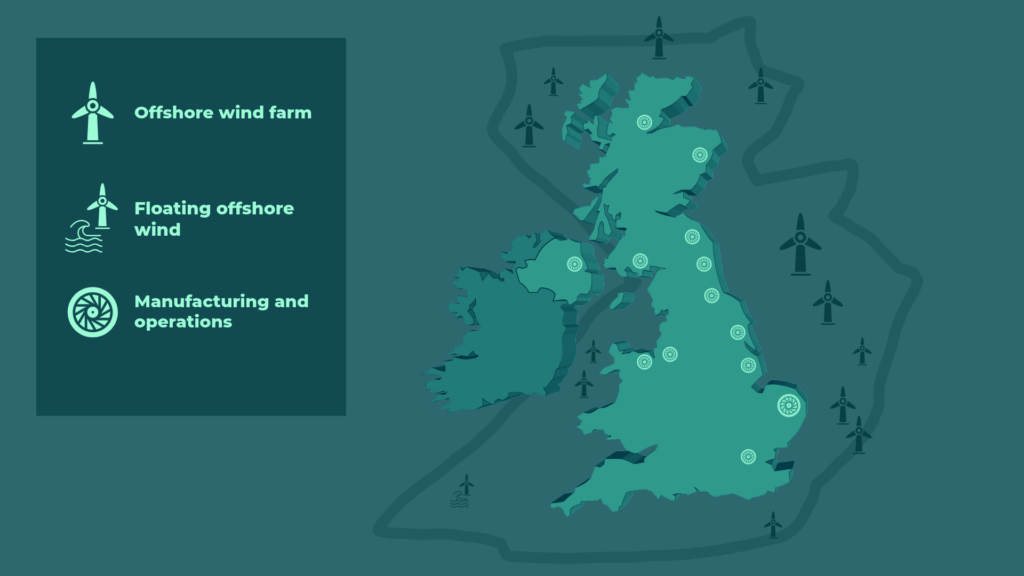
*The above illustration is simplified, but covers the UK’s main offshore wind farm zones.
What is the biggest offshore wind farm in the UK?
The UK is home to a few large offshore wind farms, including Hornsea 1 and 2, which are the largest in the world!
Hornsea 1 became fully operational in 2020, and was actually double the size of the next largest offshore wind farm at the time. Its sister project, Hornsea 2, was completed in 2022 and snatched the podium in both size and cost – it was built at the lowest ever contract price in UK offshore wind, and now provides over 1.3 GW capacity to the grid.
Offshore wind is at the heart of the UK’s clean energy transition, and capacity expansion hasn’t stopped with the Hornsea developments. There are numerous smaller farms in planning stages; and one which will dwarf them all.
The Dogger Bank development is located off the North East coast, and is intended to provide 3.6 GW when completed. This is more than both Horsea developments combined, and is enough capacity to fully power up to 6 million homes every year.
Work began on the Dogger Bank project in 2010, and it’s expected to come online in three phases. Despite delays and a global pandemic, in 2023 it produced its first power. Construction is not yet finished.
How is the UK’s offshore wind industry financed?
Influence runs deeper than the owners and operators of offshore wind, however. The ways in which the industry is financed and invested also affect energy outputs and policy or company shifts.
The UK’s offshore wind industry relies on a hybrid public-private financing model combining government revenue support, institutional investment, debt financing and targeted public funds to de-risk projects and attract capital at scale.
1. Revenue support through Contracts for Difference (CfDs)
At the centre of offshore wind financing is the UK Government’s Contracts for Difference (CfD) scheme. In short, it’s intended to act as a long-term revenue stabilisation mechanism (and does seem to work accordingly, for the most part).
Under CfDs, renewable energy developers bid competitively in allocation rounds to secure a guaranteed “strike price” for electricity over around 20 years. If the wholesale price falls below this strike price, the government tops up the difference; if it rises above, the developer returns the excess. This effectively smooths revenue forecasts and makes projects more bankable for lenders, underpinning both equity and debt finance commitments.
Previous rounds offered pessimistic results for the future of offshore wind in the UK, but this has picked up again recently – putting offshore wind back at the core of UK renewables.
2. Equity and institutional investors
Developers typically fund offshore wind projects with a mix of shareholder equity and project debt. Institutional investors such as pension funds and infrastructure funds increasingly take minority stakes in operational and near-operational assets, freeing up capital for further deployment while enjoying stable, long-term returns.
Joint ventures and strategic partnerships (such as between utilities and private equity firms) are also common, sharing risk and amplifying capital capacity for large-scale sites.
3. Project finance and debt instruments
Banks and financial institutions provide debt structures that cover a significant portion of upfront capital costs (sometimes around 60–70 % of total financing) with equity covering the rest.
These debt facilities are secured against project assets and future cash flows (often underwritten by CfDs or long-term power purchase agreements). For example, major wind projects have secured multibillion-dollar senior debt packages backed by future revenues from CfDs and commercial PPAs.
Export credit agencies and international lenders (e.g., Japan Bank for International Cooperation co-financing offshore transmission finance) also participate, broadening the pool of available capital.
4. Public finance and strategic investment funds
Government-linked bodies play a catalytic role in financing and lowering risk:
- Great British Energy (GBE) and its Supply Chain Fund offer capital grants to strengthen UK manufacturing capacity for key offshore components
- The National Wealth Fund (formerly the UK Infrastructure Bank) makes direct equity or debt investments in emerging offshore projects, including early-stage tech (e.g. floating offshore wind)
- The Clean Industry Bonus within the CfD framework provides extra revenue support for projects that invest in UK supply chains or community benefits
5. Blended finance and market mechanisms
Blended finance approaches (which combine grant funding, concessional loans, and commercial capital) are increasingly used to bridge financing gaps for first-of-a-kind technologies – see floating offshore wind.
This model reduces the cost of capital for early stage investment and encourages private funders to participate alongside public backers.
From global energy giants to emerging floating wind pioneers, the UK’s offshore wind sector is built on partnership. Ownership spans borders, projects span decades, and financing blends public stability with private investment.
Together, these elements form the foundation of a rapidly expanding industry that is reshaping the UK’s energy system and setting the pace for offshore wind worldwide. With momentum building, the ability to coordinate these moving parts will define how far and how fast offshore wind can scale.
Understand offshore risk before it hits your schedule
NeuWave transforms metocean data into decision-ready insight for offshore energy projects. Our risk and weather intelligence tools support smarter scheduling, stronger financial modelling, and more resilient project planning.