
At the end of 2025, US President Donald Trump put a Stop Work Order out on all ongoing offshore wind construction projects. This has seemingly since been backtracked, with a number of projects getting the green light to continue working again, at the start of this year.
To state the obvious, the US is one of the world’s central economies and producers, and its energy and infrastructure projects affect both local and global policy and investment trends. Despite the US being a minor player in the industry, with President Trump’s clear disdain for offshore wind being ramped up throughout his second term, this is of potential concern for the sector.
So, what does the US’ offshore wind Stop Policy mean; and where did it all come from?
Let’s dive in…
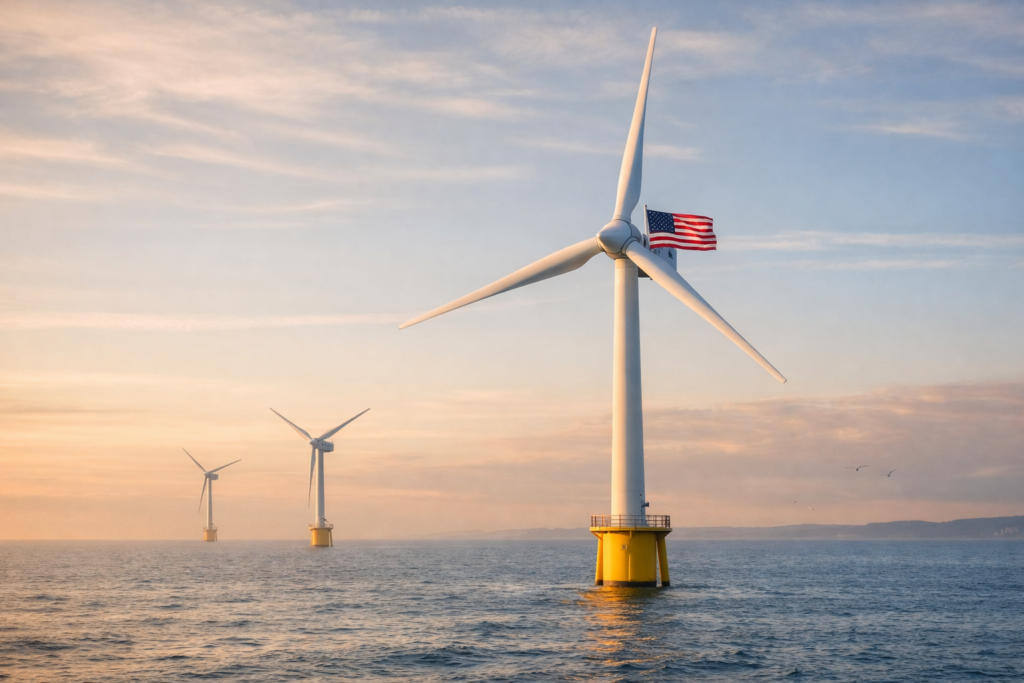
The US’ offshore wind Stop Work Order
On the 22nd December, 2025, BBC News reported that the US would be immediately pausing leases for all offshore wind projects across the country’s Atlantic coastline – including five large-scale projects in New York, Virginia, Rhode Island, Connecticut, and Massachusetts, respectively. But this was a move that had been initiated on his first day back in office, in January 2025.
The US Government cited perceived security concerns, including the potential for turbines to interfere with radar and “create other risks”, when enacting the Order.
Wind developers operating out of the United States warned that the attack on offshore wind infrastructure would cost billions in investment, and cause thousands to lose their jobs. It lands in the wake of constant attacks on the offshore wind industry, directed straight from the President’s seat in the Oval Office.
The sector hasn’t taken these attacks lying down, however. Global players Ørsted, Equinor and Dominion Energy, immediately sued (eventually successfully) on behalf of their projects.
Turning the tides – rollback in early 2026
An earlier executive order, that froze federal approval of pending offshore wind permits, was deemed unlawful by a US court last month. And as of January, 2026, the offshore wind projects affected by the Stop Work Order have the green light to continue construction and operations.
Federal courts have now intervened multiple times in the US President’s attempts to sink offshore wind, effectively restoring lost momentum for key projects and helping to underscore the limits of executive overreach. Ultimately, despite rising geopolitical tensions, the cited national security claims are not substantiated.
In mid-January, a U.S. District Court for the District of Columbia granted preliminary injunctions for major East Coast projects, starting with Empire Wind 1 off the coast of New York. The ruling allowed construction to resume while the underlying challenge to the suspension proceeds, safeguarding an almost-finalised project.
A separate Eastern District of Virginia court granted a similar injunction for Coastal Virginia Offshore Wind (the largest offshore wind farm under construction in the US) enabling work to restart on its 176-turbine build.
Within days of these respective injunctions, developers were back on site; and turbines were being installed within weeks.
The rulings here (and the need for them in the first place) highlight a deeper tension between political signalling and the legal, economic, and operational realities of large-scale energy infrastructure in the United States. Offshore wind in the US has proven to be resilient, and shaped as much by courtrooms and policy reversals, as by the winds themselves.
To understand why this latest chapter unfolded as it did, let’s take a step back.
The history of offshore wind in the US
The use of wind power throughout history has been diverse and wide-ranging, from wooden windmills to high-tech offshore floating turbines.
In the United States, the US Wind Engine Company was established in 1850 (likely a bit earlier than you expected) by Daniel Halladay and John Burnham. From the end of that century, wind power was being widely used by farmers and ranchers across the country to help pump water for irrigation, and to generate electricity for homes or businesses.
With the invention of steel blades in the 1890s, windmills became gradually, increasingly more efficient over the coming decades. Skyrocketing gas prices in the 1970s, almost a century on, renewed national interest in wind power alternatives; combined with growing environmentalist movements around the same time, the sector was reborn.
This led to the first utility-scale wind farms in the United States being installed in California and New Hampshire throughout the 1980s. Mistakes were inevitably made in the siting, installation, construction, and operations methods; but lessons were also learned.
The first commercial offshore wind farm in the US, the Block Island Wind Farm in Rhode Island, launched operations in 2016 (with construction having begun over a year prior). While modest in scale, Block Island was proof of concept for offshore wind being viable in the US. More importantly, it gave regulators and developers something tangible to build from.
In the years that followed, federal leasing accelerated, particularly along the Atlantic seaboard (recently threatened by President Trump’s recent Stop Work Orders). States are setting ambitious capacity targets and catalysing supply-chain investment. Progress, however, has rarely been linear.
Permitting complexity, shifting political priorities, cost inflation and public scrutiny have all slowed momentum at various points. That stop-start pattern is the crucial context for today’s ongoing policy turbulence.
Donald Trump and offshore wind policy
The unavoidable truth is that Donald Trump has long opposed wind energy, and has spent almost a decade stalling offshore wind projects. His disdain for offshore wind has been on show since day one of his second term, but the issue runs much deeper (and much further into the past).
Pre-presidential opinions
Donald Trump’s crusade against wind energy arguably started almost half a decade before his first term as President of the United States.
Speaking as an “expert” witness on green energy targets, he objected to the construction of 11 offshore wind turbines in Scotland in 2012 (all of which would go on to eventually be built). His argument that so-called “windmills” (read: turbines) would ruin the view from his golf courts, the future US President’s first assault on offshore wind was dismissed.
But the episode established a pattern and in the years that followed, Trump repeatedly framed wind energy as unreliable and economically damaging. These were claims that he would go on to echo throughout media appearances and public statements well before entering popular politics. He argued that wind power was overly subsidised, visually intrusive, inefficient, and detrimental to local communities, particularly coastal and rural ones.
While these positions were rarely supported by evidence, they resonated with a broader scepticism towards climate policy and renewable mandates.
By the time Trump launched his first presidential campaign in 2015, opposition to wind energy was already a well-worn talking point; a personal conviction the man carried with him into office.
First term policies
Throughout his first term, President Trump solidified his support of fossil fuel infrastructure over low-carbon alternatives. While the Trump White House leaned heavily into oil and gas production (going as far as to sell offshore wind assets) its approach to renewables was consistently less supportive.
Department of the Interior press releases from 2018 show Republican officials touting planned wind lease auctions off Massachusetts and environmental reviews for Rhode Island projects, framed as part of broader “energy strategy,” rather than a clean-energy agenda.
It marked a deeper ambivalence, though, and when returning to office in 2025 Trump made a quick-shift from cautious engagement to outright obstruction.
Second term continuation
For the last year, Trump has used his position in the White House to limit development of renewable energy infrastructure and roll-back the Biden-backed initiatives of the previous four years.
With his attention creeping outwards again, in June 2025, President Trump issued a warning to the UK over proposals to build a Chinese-owned turbine manufacturing factory in Scotland. Again citing national security concerns, a Chinese analyst instead suggested the policy represented protectionism under the guide of national security.
Over the course of 2025, the Department of the Interior went further. It rescinded designated wind energy areas across more than 3.5 million acres of federal waters and eliminated the requirement to schedule future lease sales (shutting the door decisively on new projects).
Meanwhile, ongoing construction faced constant scrutiny, and the Revolution Wind project in the Northeast was halted at 80% completion, with the department filing to vacate approval for Maryland’s US Wind project, sparking the fresh legal battles we mentioned earlier.
A lasting impact – what does it all mean?
The mainstream media commentators are divided on whether President Trump is winning or losing in his political theatre against the offshore wind sector.
Even before his second term began, offshore wind developers were already recalibrating for the risks; and when federal leasing and permitting abruptly froze in early 2025, industry players were able to react. Financial analysis warned that the related uncertainty alone could slash projected US offshore and renewables capacity far below planned targets.
The potential implications may include:
- Capital flight and cost inflations: With lease sales halted and policy signals in flux, many global developers have delayed or abandoned their US ventures
- Industrial ecosystem risks: Offshore wind relies on specialised ports, shipyards, assets, vessels, and manufacturing methods – representing billions in related federal funding that has been cancelled under Trump-era policy
- Policy versus markets: The administrations of Biden and Trump have pulled the US energy policy in opposite directions; earlier federal plans for offshore capacity are now highly uncertain
- Legal and regulatory precedent: Courts are already pushing back on executive actions, and ongoing litigation may curb future regulatory overreach and reshape how offshore wind is governed beyond single administrations
The full impact will play out over the coming years, not months. But the Trump era’s reshaping of federal offshore wind policy has already had a lasting effect on investor confidence, renewable energy output and forecasts, supply chain timing, and the strategic calculus of global energy companies.
The US offshore wind sector is no stranger to uncertainty, but recent policy reversals have exposed just how vulnerable large-scale infrastructure can be to political headwinds.
Whilst the courts this year have restored momentum in the short term, long-term confidence depends on regulatory stability and better decision-making frameworks. Offshore wind in the US will likely continue, but progress will remain uneven unless policy is grounded in operational reality rather than political rhetoric.
Policy is uncertain, but operations don’t have to be…
When policy shifts, clarity offshore matters more than ever. NeuWave provides high-resolution wave intelligence to support safer, more resilient offshore decision-making.